
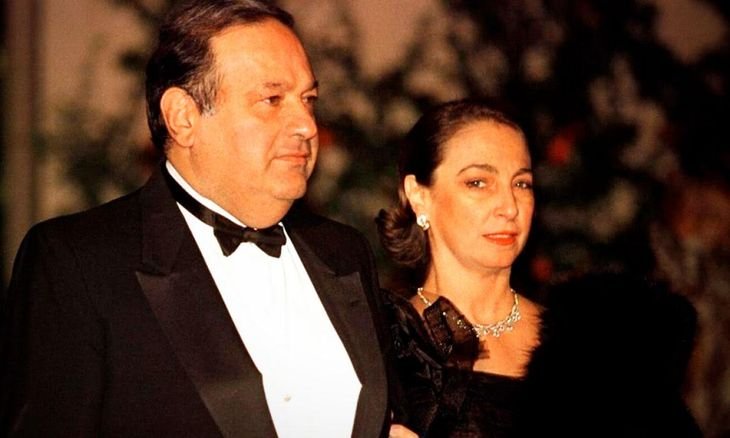
Most people come across the name Soumaya through Mexico City’s Museo Soumaya — one of Latin America’s most visited cultural institutions. But fewer know much about the woman behind that name. Soumaya Domit Gemayel was the wife of Mexican billionaire Carlos Slim Helú, and her name has remained quietly present in public life long after her death in 1999.
This article covers who she was, where she came from, her marriage to Carlos Slim, their six children, and the legacy attached to her name today. It also clears up a common point of confusion between her and her daughter, who shares a very similar name.
Who Was Soumaya Domit Gemayel?
Soumaya Domit Gemayel was born in 1948 and died in March 1999 at the age of 51. These dates come from genealogy records on platforms like MyHeritage and FamilySearch, which should be read as genealogy-source information rather than independently verified civil records.
She is best known as the wife of Carlos Slim Helú — one of the wealthiest people in the world — and as the person for whom Museo Soumaya was named. Beyond that, she was not a public figure, a business executive, or a celebrity in her own right. Her public profile exists almost entirely through her family connections.
Readers searching for her name may encounter several variations. She was born Soumaya Domit Gemayel, took on the married name Soumaya Slim Domit, and is sometimes listed in genealogy records as Soumaya Gemayel Slim Helú. All of these names refer to the same person. This matters because online searches frequently mix up her name with that of her daughter, Soumaya Slim Domit, who is a separate individual born around 1970.
Her Family Background and Lebanese-Mexican Roots
Soumaya came from a Mexican family with Lebanese heritage — a background she shared with Carlos Slim, whose father emigrated from Lebanon to Mexico in the early twentieth century. This shared cultural identity is noted in several biographical accounts of the Slim family.
According to FamilySearch genealogy records, her parents were Antonio Domit Dib and Lily Gemayel. The same records list her siblings as including Amine Pierre Gemayel, Bashir Gemayel, María Emili Domit Gemayel, and Pedro Domit Gemayel. It is worth being careful here: the surname Gemayel is associated with a well-known Lebanese political family, but no independently authoritative source confirms the exact nature of any connection between Soumaya’s family and that broader Lebanese family. The sibling details come from crowdsourced genealogy platforms, and they should be treated accordingly.
What is clear is that Soumaya’s heritage placed her within Mexico’s Lebanese-Mexican community — a community that has produced a number of prominent business and public figures. Her family background was an authentic part of who she was, and it formed a real point of connection with the man she would marry.
Her Marriage to Carlos Slim and Their Six Children
Soumaya and Carlos Slim married in the mid-1960s. Sources differ slightly on the exact year — MyHeritage lists 1966, while other biographical accounts suggest 1966 or 1967 — so a precise date is best left as approximate rather than stated as settled fact.
Together, they had six children:
- Carlos Slim Domit
- Marco Antonio Slim Domit
- Patrick Slim Domit
- Soumaya Slim Domit
- Vanessa Slim Domit
- Johanna Slim Domit
Their daughter Soumaya Slim Domit was named after her mother. She has since been associated with cultural work connected to Museo Soumaya, which is one reason the two names are so often confused in online searches. The daughter is an active, living person with her own public identity. The mother, Soumaya Domit Gemayel, passed away in 1999.
Biographical sources describe Soumaya as having philanthropic interests during her lifetime. However, the available record does not document specific organizations she founded or led, so it would not be accurate to present her as the architect of a major charitable program. What is documented is that she was described as a caring and family-centered person, and that her husband’s public statements reflect deep personal loss after her death.
According to a cultural history of Museo Soumaya, Soumaya had kidney disease and had undergone a kidney transplant before she died. This detail comes from a Mexico News Daily account of the museum’s background. It is included here not to define her by her illness, but because it appears in public reporting about the family and the museum’s origins.
The Name Behind Grupo Carso and Museo Soumaya
Two of the most visible places where Soumaya’s name has continued after her death are Grupo Carso and Museo Soumaya.
Grupo Carso
Grupo Carso is Carlos Slim’s major holding company, and its name is reported to be a combination of “Carlos” and “Soumaya.” This detail has been cited in several background accounts of Slim’s business history. It suggests how personally significant she was to him during the years when his business empire was being built. That said, the name connection does not mean Soumaya held any formal executive role in the company — no reliable source supports that claim.
Museo Soumaya
Museo Soumaya is the clearest and most lasting public expression of her memory. Carlos Slim established the museum as a cultural institution named in her honor. Its most prominent location — the distinctive silver-domed building at Plaza Carso in Mexico City — opened in 2011, more than a decade after her death.
The museum houses a significant collection of art and artifacts, much of it drawn from the Slim family’s personal collection. It is free to enter, which has made it one of the most visited museums in Mexico. The decision to open it to the public without a ticket price reflects a philanthropic spirit, whatever the institutional motivations behind it.
For most people, Museo Soumaya is simply a remarkable building full of interesting art. But the name on the building is a real person — a woman who lived, raised six children, and died at 51. The museum is how Carlos Slim chose to keep her name part of the city’s public life.
For those interested in learning more about public figures connected to major business families, BusinessVerb covers a range of profiles and background features on prominent names in business and culture.
Separating Soumaya Domit Gemayel from Her Daughter
This is worth stating plainly because the confusion is genuinely common. Soumaya Domit Gemayel and Soumaya Slim Domit are two different people.
The mother — the subject of this article — was born in 1948 and died in 1999. She was Carlos Slim’s wife and spent most of her life outside the public eye.
The daughter — Soumaya Slim Domit — was born around 1970, according to FamilySearch records. She is the couple’s fourth child and has been publicly associated with cultural and philanthropic activities connected to Museo Soumaya. She is alive and active.
When search results or social media posts refer to “Soumaya Slim” attending an event or speaking about the museum, they are almost certainly referring to the daughter, not the mother. Keeping that distinction clear matters for anyone researching the family accurately.
Why Her Name Still Matters
Soumaya Domit Gemayel was not a celebrity in the conventional sense. She did not hold public office, run a company, or court media attention. What she did was build a family with one of the most influential businesspeople of the twentieth century — and, in doing so, leave a name that has outlasted her in some very public ways.
A museum bearing her name draws millions of visitors. A major holding company carries her name within its own. Her six children remain prominent in Mexican business and cultural life. And the Lebanese-Mexican heritage she carried has become part of the broader story of how immigrant families shaped modern Mexico.
That is a quiet kind of legacy, but it is a real one. Her story is a reminder that the names we encounter in public spaces often belong to people whose lives were mostly private — and that getting those names right, and understanding who they actually were, is worth the effort.
Read Also: